Tuesday, 10 March 2015

Some Real Chasing

This weekend, Eamon, Lauren, and I went to chase some life birds and rarities in Louisiana.  We started the trip off with a stop in City Park of New Orleans to look for a Black-throated Grey Warbler among a few other early warbler migrants and wintering songbirds.  After a nice walk through a section of the park, we ended up giving up on finding the bird.  This wasn't terribly upsetting since we ended up getting coffee and beignets before a walk through some other sections of the park.  After some more birding through City Park, we enjoyed some great barbecue before deciding to make a chase after some Scissor-tailed flycatchers about an hour down the Mississippi River from New Orleans.  Upon reaching the area where the flycatchers were reported, we caught a glimpse of a Western Kingbird by the roadside, but continued after a brief look to find the Scissor-tailed Flycatchers.  After searching some nearby fields, we decided to go back and look around the Western Flycatcher for the Scissor-taileds, which turned out to be a great idea.  The Western was flycatching along a levee, so I decided to climb to the ridge and see what was on the other side.  As I climbed the hill, a Scissor-tailed gave an annoyed chatter and quickly flew away from me.  I was yelling with excitement at yet another life bird in the flycatcher family, and Eamon and Lauren were right with me as we crested the levee to find another Scissor-tailed foraging as well.  All three of the flycatchers were very hesitant to let me get close enough for some good photos, but that was just going the be the story for this whole weekend.  It was really fun to watch the longer-tailed of the two Scissor-taileds flycatch with such a long tail!

Scissor-tailed Flycatcher
After enjoying the flycatchers for as long as possible, the three of us decided it was time to head to Grand Isle, LA to chase after a Lucy's Warbler.  For a while I was listing, now I am chasing, and I've enjoyed doing both for these little stints at a time throughout my time as a bird watcher.  The Lucy's Warbler was particularly exciting to see because it has a normal range in the mesquite deserts of the southwestern US.  Many of the life birds I have been getting are western vagrants showing up on the Gulf Coast.  We got into Grand Isle a little after dark to set up camp on the beach at the state park.  It was extremely windy, and a little bit difficult to set up tents, but it ended up being a warm and beautiful night to walk the beach before heading to bed.  In the morning we got up and birded the shores a few steps from our tents.  The usual winter shorebirds such as Willet, Black-bellied Plover, and Sanderling were all in attendance.  We packed up camp and quickly made our way to the spot where the Lucy's warbler had been reported a couple of weeks earlier.  I was a little nervous that we had missed our chance to see the bird since it hadn't been reported in a decent amount of time.  After a slow walk to the back of the Nature Conservancy property, we patiently walked and searched for the Lucy's in the thick Baccharis stand.  After searching and searching, I think we were all thinking we had missed our chance, when it slowly started to rain.  As we reluctantly were fighting the urge to get to the cars before getting soaked with rain, the Yellow-rumped Warblers seemed to get very active and a bunch of birds began flying from the shrubs and up into the oak trees above the pathway we were walking.  Eamon and Lauren both thought they caught a glimpse of the Lucy's in the shrubs during all the commotion, and then Eamon and I saw a smaller lighter colored bird make a flight out of the Baccharis and into an oak.  We had luck on our side!  We all got about a minute or two of enjoying the Lucy's through our binoculars before it moved along with the flock of other warblers out of our sights.  This also meant that I wasn't able to get any pictures, but getting a great look at the bird and enjoying just watching will always be more important than trying to get a shot through the viewfinder.  Among the flock of warblers there was also a Tennessee Warbler and Northern Parula mixed with the expected Orange-crowned Warblers and plentiful Yellow-rumped Warblers.
Northern Harrier
Northern Harrier
Following the great showing by the Lucy's Warbler, the rain really began to start coming down so we had to quickly get back to the car.  We decided to try to do some car birding just to prolong the birding weekend and we ended up seeing a juvenile Northern Harrier catch a Red-winged Blackbird.  The orange tinging to the breast and face are typically what I use to determine the age of harriers, but apparently the dark central rectrices (tail feathers) are another diagnostic field mark for determining the age of harriers.  This can be seen in the photo above.  On our drive off of the island we were surprised by a large pink bird foraging in the marsh.  None of us thought about the chance of seeing Roseate Spoonbills, and it was a life bird for Eamon so we turned the car around to take a nice look through the scopes at this strange-looking, yet beautiful bird.
Roseate Spoonbill
Some minor outings to look for other rarities and life birds resulted in even fewer decent pictures than the trip to Grand Isle.  One of these outings was a visit to a landfill in Alabama where and Iceland Gull was reported multiple times in addition to some sightings of Franklin's Gulls.  When we got to the landfill area we quickly realized that it was going to be very difficult to scan through the thousands upon thousands of gulls at the dump.  We think there were at least 5,000 gulls, but could have been even 10,000 since we couldn't see where all the gulls were landing.  We ended up missing both species because rain was coming, the wind was strong, and staring around at a dump really wasn't all that entertaining after the first hour or so.  It was still impressive to see so many gulls in one place.
You can try to find the Iceland and Franklin's Gulls in here.  We sure couldn't!
Inca Doves
Eamon found a small flock of Inca Doves in downtown Ocean Springs, MS while taking a walk one afternoon.  This was another lifer for me, so the next day we went to find them again without much difficulty.  It was another dark dreary day, so none of the pictures came out well, but these are really a beautiful dove!  The "scale" look is quite unique, and certainly handsome.  One other great lifer was a Say's Phoebe on the Mississippi State University campus that Eamon and I took a couple minutes to find while picking up some equipment for my project.  I didn't have my camera, though I wish I would've brought it along!  The phoebe was flycatching at the edge of a hill and kiting almost like a raptor until it saw a tasty insect.  The bird didn't seem wary of us, and was a real joy to watch forage and fly.  This has been an amazing winter for lifer flycatchers.  Western and Tropical Kingbirds, Say's Phoebe, and Scissor-tailed Flycatcher being the lifers, and I will never complain about seeing Vermilion Flycatchers.  It has been a lucky and fun winter so far, and spring migration is just around the bend.  In fact, the early movers are already coming in!

Sunday, 8 February 2015

Life Birds and Rarities

It has taken me longer than I would've liked to get this post up.  The past month has been filled with more life birds than I've seen in a long while, many of which were rarities for the area, though somewhat regularly so on the Gulf Coast.  As I would think about editing photos and writing up a post, yet another rare bird would pop up for a chase, in addition to many other exciting outings and rarities that weren't lifers, but amazing just the same.  My year started off with a bird that I had hoped to see two years ago here on the Gulf.  Unfortunately, we didn't even hear a report of the Groove-billed Ani then, but this year my advisor Scott found one about an hour away, gave me a call, and I rushed over to Meaher State Park faster then I've ever moved to chase a bird species.  Coincidentally, Meaher park was where I lived last fall while working as a bander for a fall migration study, so I knew exactly where Scott described the bird was hanging out.  Without much effort, I walked down the trial towards the boardwalk and the bird popped out making its rather adorable call.  Sadly, the lighting wasn't great for photos, and these birds love bashing around in dense shrubby habitats.  Here are a couple shots of this great bird, just the same:

Groove-billed Ani

After the Ani, I finally went to chase down a Tropical Kingbird that had been found on the CBC by another group of birders.  I was lucky enough to have Eamon and Lauren along for the birding and the search for the Kingbird, and we eventually found him. It was a lot of fun to see a new Kingbird species since they are really enjoyable to watch as they flycatch and zip around from perch to perch, occasionally making a ramped up call.  Life bird number two for the year!
Tropical Kingbird with a Mourning Dove for size comparison

All throughout these life bird adventures there have been plenty of shorebird and waterbird trips as well.  It has been a lot of fun to watch shorebirds and their behaviors, and the seasonality of birding is really what keeps it from ever getting boring.  For now, it is a lot of fun to spend my time staring through a scope on the beaches and the water, but by the time migration comes along, I'll be ready to be using both eyes through my binoculars a bit more often.  
Willet
Black-bellied Plover
Marbled Godwit
Ruddy Duck
A group of us, led my advisor Mark, took a pilgrimage to find a Vermilion Flycatcher in an attempt to get away from the shorebirds for a day.  Although this wasn't a life bird, I would gladly chase after this species any time as their bright red plumage is quite amazing, and all flycatchers are so fun to watch.  This trip turned out to be awesomely successful on the Vermilion front, but we also managed to see a couple of Vesper Sparrows (sadly no photos!) and a tree full of Brewer's Blackbirds.  These are both somewhat uncommon to see, but really awesome to pick out of the surrounding common species.  The flycatcher was on a family farm area in southern Mississippi, and the landowners were extremely welcoming and definitely excited to share a view of the bird with us.  After having a great view of the Vermilion, we decided to see if we could turn up a Bullock's Oriole back on the coast.  After some waiting, and just hanging out on the street where the bird had been reported, the Oriole dropped down to a favorite hummingbird feeder.  This bird also happened to be on a property of someone that Mark knew, and he welcomed us inside to view the feeder from their living room.  The only picture I could manage was pretty dark, and through a window, but still proof of life bird number three for the year!
Vermilion Flycatcher

Brewer's Blackbird
Bullock's Oriole
There are plenty of other common birds around that are lots of fun to watch, and most of the birding trips I have done haven't revolved around any attempts to see life birds.  Lately, I have been fortunate enough to visit the barrier islands to do a winter plover survey and spend a bunch of time out on the water where I will be doing my master's project.  This has given me lots of time seeing the marshes, driving the boat, and enjoying being outside.  The other day, Mark, Eamon, and I were able to sneak up to a small island right behind a large group of Redhead.  This was probably the closest I'd ever been to this species of duck, and it was amazing to scope these birds from so close and catch all their details.  It has been great to be surrounded by birder's that enjoy the chase for rarities, but also enjoy the common species, their behaviors, and the sometimes overlooked beauty they show.
Loggerhead Shrike
Nelson's Sparrow
Marsh Wren
American Pipit


Monday, 5 January 2015

Christmas Bird Count

Just before leaving for a holiday break, I was able to get out on a Christmas Bird Count, or CBC, with Mark and Allison in Jackson County Mississippi.  Our portion of the survey had us out on a boat with Mark as our captain through the marshes.  The day started out at dawn and before long we were lucky enough to come across a Merlin sitting in a tree near the Louisiana border.  We had some trouble scrounging up some winter warblers and other song  They are quite amazing little falcons, and this individual lets us sneak up fairly close for some decent photo opportunities.
Merlin
For our portion of the count we were particularly on the lookout for ducks and marsh birds that others on land may not be able to find.  We managed to scrounge up some Black Scoters fairly early in the day, which was a great surprise as they are fairly uncommon and sparsely distributed in the area.  We were all a little confused at first since they seemed so dark and flew pretty strangely compared to everything else we were expecting in the waterfowl category.  Mark spotted a Common Goldeneye as well, which was a nice find!  We continued through the marsh with stops to look for Seaside Sparrows and LeConte's Sparrows, as well as shorebirds on mudflats, and songbirds in patches of Live Oaks.  Along the bay side of the marsh we also spotted some River Otters, which was a new sighting for me on the Gulf.  The ragged Seaside Sparrow below wasn't shy about foraging for insects on the shell piles right in front of us!  Usually these birds are a bit more secretive, and stick to the grasses and shadows, but this bird even snatched insects up from right in front of our feet and wouldn't stay still for a second.
River Otters in the salt marsh
Seaside Sparrow in pretty ragged condition
Wilson's Snipe skulking at the water's edge
Peregrine Falcon flying away
Dunlin pair
The highlights of the trip were a Long-tailed Duck and a Western Kingbird.  The Long-tailed Duck was a lucky spot as we were rushing back to try to pick up a duck decoy we found in the marsh, but forgot to clear out.  We had some pretty amazing close up views of a duck that I have never seen closer than 50 yards. Perhaps one of the best quotes of the day was said by Mark just after viewing the Long-tailed Duck, "There's nothing better than TatoNuts and Long-tailed Ducks!" For those who have never experiences TatoNuts, they are a doughnut maker in southern Mississippi that uses potato flour in the making of their doughnuts.  Mark is always kind enough to bring some along for the big days of birding!  This bird appears to be an adult female in winter plumage.  As we raced the sunset back to the boat ramp and to find a few more species for the day, Allison spotted a bird perched conspicuously at the top of a tree.  At first she thought it was an Eastern Phoebe, but the breast was very yellow and the bird looked a bit too big.  After some serious looks and guesses, it was clear that is was a kingbird native to the western US, but it took us some scoping, pictures, and consulting of our field guides to be sure that we had seen a Western Kingbird.  We spent most of the rest of daylight checking this bird out, which was a lifer for me.
Long-tailed Duck

Western Kingbird (we think!)

Monday, 1 December 2014

Back to the Gulf

My adventures, and now my studies, have led me back to the Gulf Coast of Mississippi.  I will be spending a good deal of time here, so be ready to see plenty of shorebirds, gulls, and ducks over the coming months.  I have been able to get out on the boat to learn how to drive through the marshes and see some of the local hot spots that require a boat to bird.  I am looking forward to another winter here on the coast for some more of the best birding I've ever done.  The first few weeks reintroduced me to some shorebirds and waterbirds I hadn't seen in a while, but aren't rare in any sense of the word down here on the gulf.  Dunlin, dowitchers, and black skimmers were some of the first with which I was happy to get reacquainted.  Black skimmers are truly strange looking, but amazing to watch as they glide above the water with their mandible skimming through the surface.  When they feel the mandible collide with a fish they dip their head and close their mouth for the capture.
Black Skimmer

Black Skimmer foraging
Dowticher species, most likely Short-billed Dowitcher
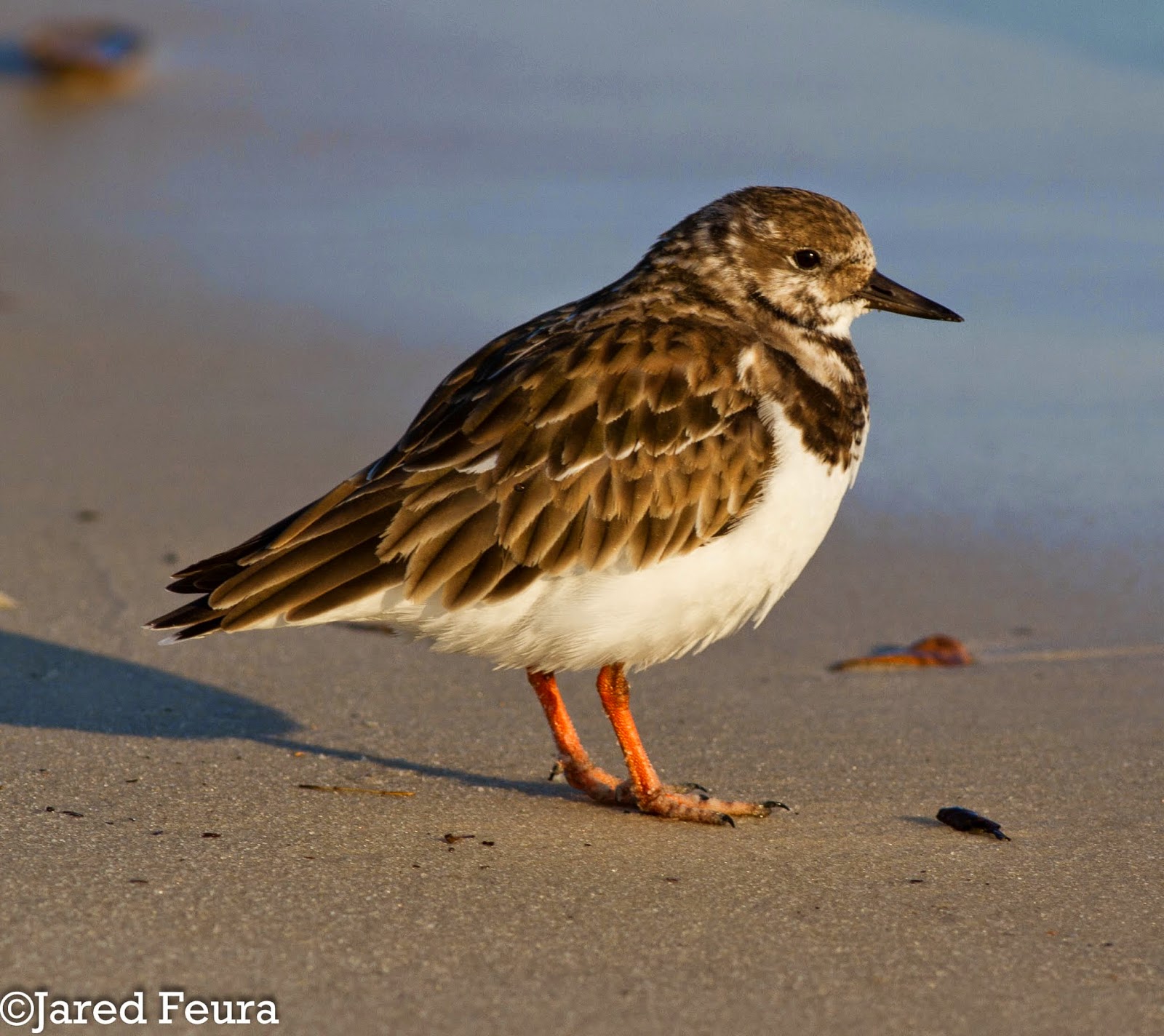
Ruddy Turnstone
A line of Laughing Gulls
Juvenile Ring-billed Gull
Forster's Tern
Marbled Godwits at sunset
Lesser Yellowlegs
Willet
Most likely a Short-billed Dowitcher foraging
I have been undergoing boat training in the marshes, which has been a lot of fun.  I feel very fortunate to be spending so much time out on the water and getting to bird along the way.  There have been huge rafts of Redheads and Lesser and Greater Scaup which will move out to sea now that the hunters are giving them reason to be wary of the marshes and shallower shorelines.  Bufflehead, Pied-billed and Horned Grebes are also around in some numbers, flying away from the boat with their stubbly little wings and their desperate looking wing beats.
This past weekend I went birding with the local Audobon chapter and my advisor, Mark, to look for shorebirds along the coast.  Along the way we went through some brackish ponds a little ways in from the shore.  A stop to look at a few ducks and terns on the water resulted in a surprise for me, however.  As I got back into Mark's car and we began driving away, we flushed up a dark little bird from the drainage at the side of the road.  I had a similar situation happen before, so I immediately jumped out of the car and began hoping the bird would stick its head out from the marsh grasses into which it had run.  It was certainly my second sighting of a Black Rail!  I was extremely excited, well, I still am extremely excited, to have had another chance to see such a uncommon and secretive bird.  Although there were no new surprises on the shorebird front on the trip, this Black Rail certainly made the end of my year on the birding front.  

Sunday, 26 October 2014

An ending to Maine

Maine, Maine, Maine.  I don't think there is a bad thing about the areas I visited during my time in Maine.  I may have been apprehensive about living out of a tent and trailer at first, but the peninsula won my heart very quickly.  It was great to be able to hear the ocean all the time, especially at night in the tent.  Although it gets old living out of a tent, a rainstorm on the coast in a tent, on occasion, makes it all worth it.  It seemed so strange to have gulls constantly flying over the spit of land that we inhabited as they moved to the water on the other side, but it really helped my gull identification to have such constant flyovers.  There were also lots of raptor flybys with sharp-shinned hawks and merlin actively hunting as the strong ocean breeze blew them along.  The few peregrines that could be seen moving through were really a special treat.  Watching raptor aerobatics on such strong winds and so close was just like being at a hawk watch, though with a view much closer to sea level.  The peninsula is bisected by a length of private property where some amazing folks spend their spring, summer, and fall.  I was lucky enough to meet many people who have loved the point for much of their lives, and who's families have had their houses there for generations.  It was easy to see why they would keep coming back, and work to keep the point as undeveloped and as untouched as possible.  While we were taking down nets, we were given an amazing look at a spruce grouse that walked right up to us without hesitation.  Spruce grouse are notorious for showing no aversions to humans.  I unfortunately left my camera at the trailer, so after freaking out and actually enjoying how close this grouse was to us, I ran as fast as I could back to the trailer.  After riding my bike back down, I had to try to sneak up on the grouse, rather than just watching it walk right up to us.  Sadly, I couldn't get as close as the initial encounter, but I did still manage to get a couple of pictures with one of my shorter lenses.
Spruce Grouse
Spruce Grouse, about an arm's length away
Sadly, this is the last post I'll have about my time in Maine, but it was the best project and place I could have spent my last months before starting graduate school.